
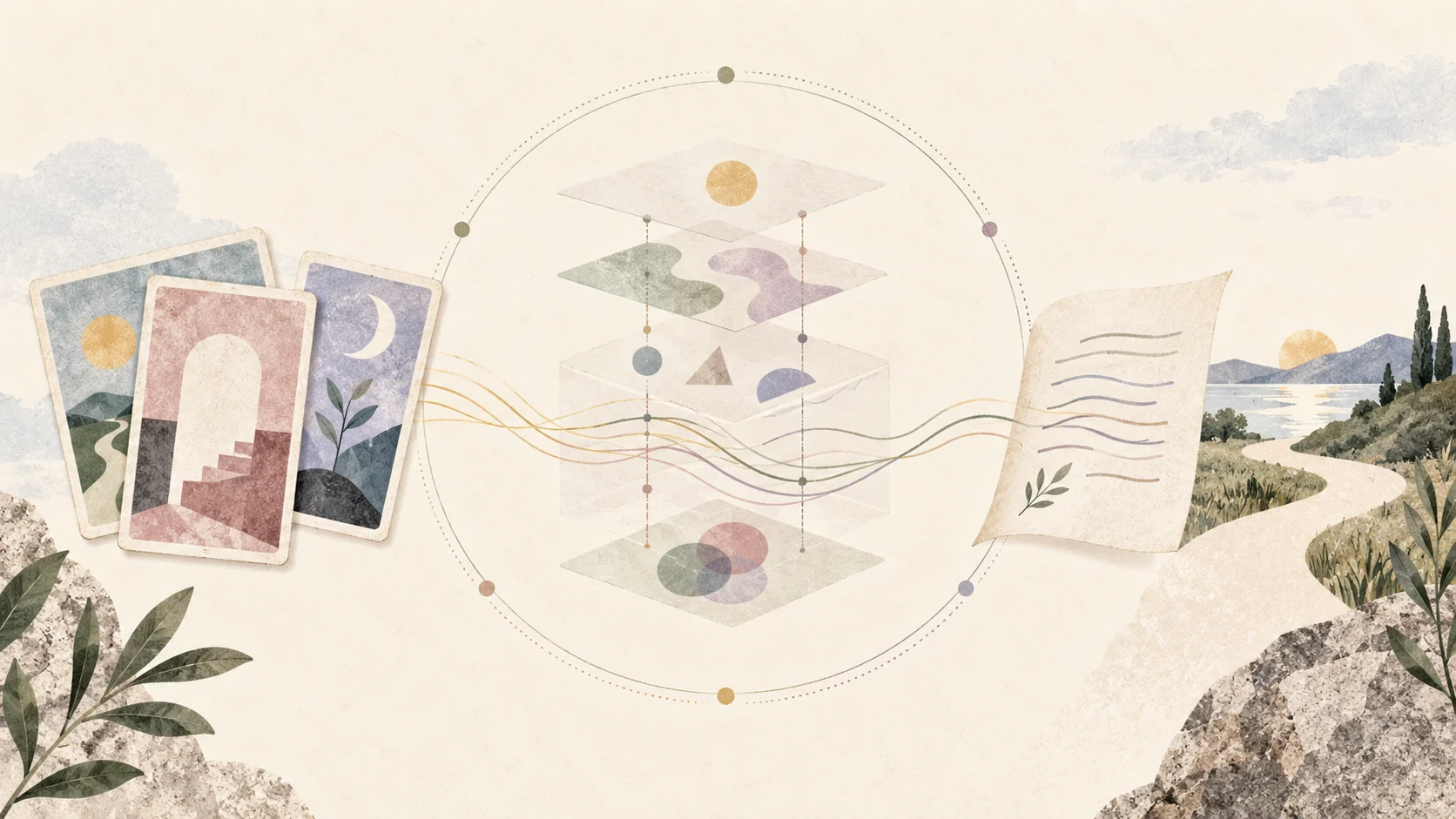
The screen makes an AI tarot reading look almost instant: ask a question, draw the cards, and an interpretation appears. That small gap between the draw and the answer hides several different jobs.
The cards do not contain a secret message that the software simply reveals. The system has to keep track of the question, the spread, the position of each card, whether it is upright or reversed, and the meanings attached to those cards. Then a language model has to turn that material into an answer that reads as one interpretation rather than a pile of definitions.
Understanding that process makes it easier to judge what an AI tarot reading is good at, where it can go wrong, and what information you may be sharing when you use one.
The short version: from question to interpretation
In TarotAI, an account-based AI consultation follows a sequence like this:
You bring the question. A focused question gives the reading a clearer job than a request for an all-purpose prediction.
You choose a spread and draw the cards. The layout decides what each position is asking; the same card can mean something different in “Your State” and “Likely Direction.”
The system builds the reading context. It combines the question, card names, upright or reversed orientation, spread positions, and reviewed card knowledge.
A configured AI model writes a connected interpretation. It is asked to respond to this specific spread rather than invent a reading without cards.
Safety rules and output checks are applied. Before generation, the question is checked against safety rules. High-stakes topics may receive a boundary reminder, while immediate danger can stop the card-reading flow. The model output is then validated against the expected answer structure before display.
You decide what to do with it. The output is a prompt for reflection. It is not new evidence about the world.
This is why two tarot tools can produce very different answers from the same cards. The deck is only one part of the system. The question, spread positions, source meanings, instructions, model, and quality checks all shape the result.
What the AI is actually interpreting
Your question
The question tells the system what kind of relationship to look for between the cards. “What should I know about work?” leaves almost everything open. “What am I overlooking before I accept this role?” gives the spread a narrower, more useful frame.
This does not mean a carefully worded question makes the answer true. It means the answer is less likely to drift between unrelated concerns.
The spread positions
A card is not interpreted in isolation. The position sets its job. The Hermit in “What I need” may point toward time to think; in “What is blocking progress,” the same card may raise a question about withdrawal or too little outside input.
AI can be useful here because it can hold several positions in view and describe how they support, challenge, or qualify one another. It can also fail by flattening every position into the card’s most familiar keyword. A coherent paragraph is not proof that the underlying reading was careful.
To check that synthesis yourself, read each card through its position and then connect the spread.
Upright and reversed meanings
Orientation adds another layer, but reversed does not automatically mean “bad” or “no.” It may suggest something blocked, delayed, inward, excessive, avoided, or out of balance. A responsible interpretation still has to connect that possibility to the position and question.
Is AI tarot accurate?
There is no honest percentage that can tell you whether an AI tarot reading is “accurate.” The word can mean several different things.
Did it identify the correct cards, orientations, and positions? That is a technical accuracy question.
Did it stay faithful to the spread instead of giving a generic horoscope? That is an interpretation-quality question.
Did it help you name a pattern or formulate a better next question? That is a usefulness question.
Did it prove what another person thinks or what will happen next? An AI tarot reading cannot do that.
A response can feel uncannily relevant because broad symbols give you a useful way to organize experience, because the question contains important context, or because the model is good at producing fluent language. Relevance is not the same as verification.
The most practical test is not “Did this sound confident?” Ask instead:
Did it refer to the cards and their actual positions?
Did it separate what I know from what I am assuming?
Did it leave room for more than one plausible interpretation?
Did it give me something I can check through a conversation, behavior, records, or time?
Would I still make this decision if the reading had said something else?
If the last answer is no and the decision carries serious consequences, step away from the cards before acting.
What AI tarot can help with
An AI tarot reading can be useful when you want to slow down and look at a situation from more than one angle. It can help you:
notice a pattern you have been repeating;
compare the demands and trade-offs of two choices;
separate a feeling from the facts currently available;
find a question you have been avoiding;
turn a vague worry into one grounded next step;
connect several cards without losing track of their positions.
It is most useful when it helps you put a vague concern into words you can examine.
What it cannot tell you
AI tarot cannot open a private mind, access hidden events, or inspect the future. It cannot establish that someone loves you, prove infidelity, diagnose an illness, determine whether you are pregnant, predict a court result, choose an investment, or tell you whether a dangerous situation is safe.
For relationships, the other person’s words, consistent actions, consent, and boundaries are better evidence than a card. For health, legal, financial, or safety questions, use the relevant records and qualified help. TarotAI’s public disclaimer describes these boundaries in more detail.
The system also has safety rules. It may continue a reflective reading with a clear boundary reminder for some high-stakes topics. When a message suggests immediate danger or serious harm, it can stop the card-reading flow and direct the person toward real-world support. That safeguard is not the same as monitoring: TarotAI is not a crisis service and cannot call emergency services for you.
What happens to your question?
This is the part where “AI tarot” is too broad a label. Privacy depends on the feature you use.
| Feature | How the interpretation is generated | What happens to the question |
|---|---|---|
| Anonymous Yes/No reading | A configured language model receives the question, optional context, cards, orientations, and reading settings | The relevant input is processed by the configured AI provider; the result remains in the browser session unless you save or share it |
| Anonymous multi-card spread | The initial free reading displays reviewed, prewritten card meanings | The reading remains in the browser unless you save or share it; an account-based AI consultation is a separate signed-in feature |
| Account-based AI consultation | A configured language model receives structured reading context and writes a connected response | The consultation is stored with encrypted question and answer content, and the relevant material is processed by the configured AI provider |
Anonymous readings are not all the same
According to TarotAI’s current Privacy Policy, an anonymous reading record stays in the browser unless you choose to save or share it. The current reading can be held in session storage so a refresh does not erase it, and starting sign-in creates a temporary local recovery copy.
Generation still depends on the feature. Anonymous Yes/No sends the information needed for the interpretation to the configured AI provider. An anonymous multi-card spread initially shows reviewed, prewritten meanings; moving into an account-based AI consultation is a separate signed-in step.
An account-based AI consultation
An AI consultation works differently because it supports a continuing conversation. TarotAI stores the original question, cards and positions, answer, language and safety state, credit transaction, and time in its business database. Consultation questions and answers are encrypted there.
TarotAI accounts and AI consultations are for users aged 18 or older.
To generate and safety-check a response, TarotAI may send the relevant question, conversation context, card facts, and, when needed, an internal translation to its configured AI provider. The provider therefore processes the material needed for that response, even though the copy stored in TarotAI’s database is encrypted.
Consultations remain in your account until you delete them. Deletion removes the live content and starts the erasure process described in the Privacy Policy. Limited de-identified service records and encrypted backup remnants may be retained for the reasons set out there. Optional product analytics is off by default and is designed not to collect conversation text.
Whatever tool you use, leave out passwords, payment details, health records, confidential work information, and another person’s private information. A tarot question rarely needs a full name, address, employer, or identifying history to be useful.
AI reader and human reader: not the same experience
An AI reader is available on demand, can keep track of a fixed spread structure, and can rephrase an explanation quickly. It does not have intuition or lived experience, and it has no direct knowledge of your life beyond the context supplied in the consultation.
A human reader can notice hesitation, ask an unexpected follow-up, and bring a personal reading tradition to the table. Humans also make assumptions, miss context, and disagree with one another. “Human” does not automatically mean accurate, and “AI” does not automatically mean neutral.
In either case, a good reading should make its reasoning visible enough for you to question it. You should be able to say, “That interpretation came from this card in this position,” not simply, “The reader sounded certain.”
A better way to use the result
Try dividing your notes into three columns:
| Reflection from the reading | What I can verify | What I will do next |
|---|---|---|
| I may be avoiding a direct conversation | Have I clearly asked what the other person wants? | Ask once, then listen to the answer and watch for follow-through |
| This choice may cost more energy than I expected | What are the actual hours, deadlines, and responsibilities? | Check the written details before agreeing |
| I may be treating delay as failure | Has the stated timeframe ended? Has anything material changed? | Set a review date instead of drawing again tonight |
The first column is where tarot can help. The second and third are what keep the reading connected to your life.
How to keep the reading in perspective
Treat the answer as a working note. Keep what helps you name the situation, check it against real evidence, and discard what does not fit. Sometimes the interpretation will be illuminating; sometimes it will be generic or simply wrong.
The reading is useful only while you remain the person deciding what is true and what to do next.
Frequently asked questions
How does AI tarot work?
AI tarot combines your question with the cards drawn, their upright or reversed orientation, and the role of each spread position. A language model uses that structured context and reviewed card meanings to write a connected interpretation. The result is generated language, not a supernatural measurement or verified prediction.
Is AI tarot accurate?
AI tarot may produce a relevant or useful reflection, but it has no reliable accuracy rate for predicting events or revealing private thoughts. Judge it by whether it uses the correct cards and positions, distinguishes assumptions from evidence, and gives you something reasonable to verify outside the reading.
Can AI tarot predict the future?
No. It can describe a possible direction if the current pattern continues, but it cannot guarantee an event or fixed future. New information, other people’s choices, and your own actions can change what happens.
Are AI tarot readings private?
It depends on the feature. Anonymous Yes/No sends the relevant input to a configured AI provider, while an anonymous multi-card spread initially displays prewritten meanings. Anonymous results stay in the browser unless you save or share them. Account-based AI consultations are stored with encrypted question and answer content, and relevant material is processed by the configured AI provider. Do not enter sensitive information.
Does AI tarot know what someone else is feeling?
No. It can help you examine your perception of the relationship and the behavior you have observed, but it cannot verify another person’s private feelings. Their direct words, consistent actions, consent, and boundaries are stronger evidence.
Should I use AI tarot for medical, legal, financial, or emergency decisions?
No. Use qualified professional help and real-world evidence for high-stakes decisions. TarotAI is not a crisis service and cannot monitor you or contact emergency services. If there is immediate danger, contact local emergency services and someone you trust.