
The essence
Fair judgment and responsibility for what follows.
Justice represents a decision that can be explained and a responsibility that can be identified. It values accurate information, clear agreements and standards applied consistently. Feelings deserve a hearing, but a strong conviction alone does not settle what happened or what each person is responsible for.
Justice Tarot Card Meaning — Upright
The upright card asks for intellectual honesty as well as fairness to others. That includes hearing an inconvenient account, correcting a mistaken conclusion and repairing harm where possible. A principle becomes credible through these actions. Simply insisting on being right, or applying a rule only when it suits, misses the substance of Justice.
Fairness · Evidence · Accountability · Judgment
Justice Tarot Card Meaning — Reversed
Reversed Justice can indicate biased judgment, unequal treatment or responsibility being passed from one person to another. It can also describe excessive self-blame, where every difficulty is treated as a personal failure. The concern is whether accountability matches actual conduct, not how quickly someone can be found to carry all the blame.
Unfairness may lie in the rule itself, in its application or in missing information. Separate the agreement, the known events and the responsibility of each person before drawing a conclusion. Owning a mistake does not require accepting blame for everything else, and being treated unfairly does not make that treatment deserved.
Bias · Avoided responsibility · Unequal standards
Justice Love Meaning
Justice Upright Love Meaning
The emphasis is on honesty, mutual respect and agreements both people understand. Responsibilities and boundaries can be discussed without turning every difference into an accusation. Fairness need not mean an exact split of every task; it means that the arrangement is considered and acceptable to both people.
Justice Reversed Love Meaning
Double standards, uneven responsibilities or selective accounts of an argument may be weakening trust. Describe the broken agreement or unequal treatment specifically rather than defining the whole person by it. A relationship cannot become fair through one person repeatedly accepting all the fault.
Justice Career Meaning
Justice Upright Career Meaning
Reviews, agreements, assessments and the allocation of responsibility may be prominent. Clear records and transparent criteria support a fair evaluation of the work. In study, the card favors intellectual honesty: recognize genuine gaps without dismissing what has already been learned.
Justice Reversed Career Meaning
Opaque assessment, shifting criteria or unclear responsibility can create difficulties. An overlooked detail on your own side is another possibility. Check the record before drawing conclusions, then raise specific concerns. Formal disputes need the relevant professional processes, not a prediction taken from a card.
The short answer
Is Justice a Yes or No Tarot Card?
In TarotAI’s reviewed yes or no reading system, orientation and the wording of your question both matter.
Upright: evidence-based yes
The answer does not favor you by feeling alone. It follows conduct, rules, and consequence. The more complete the facts, the more reliable the judgment becomes.
Reversed: imbalanced no
The present conclusion may be shaped by missing information, bias, or avoided responsibility. Restore complete facts and one standard before expecting a different answer.
Look a little closer
Inside the artwork
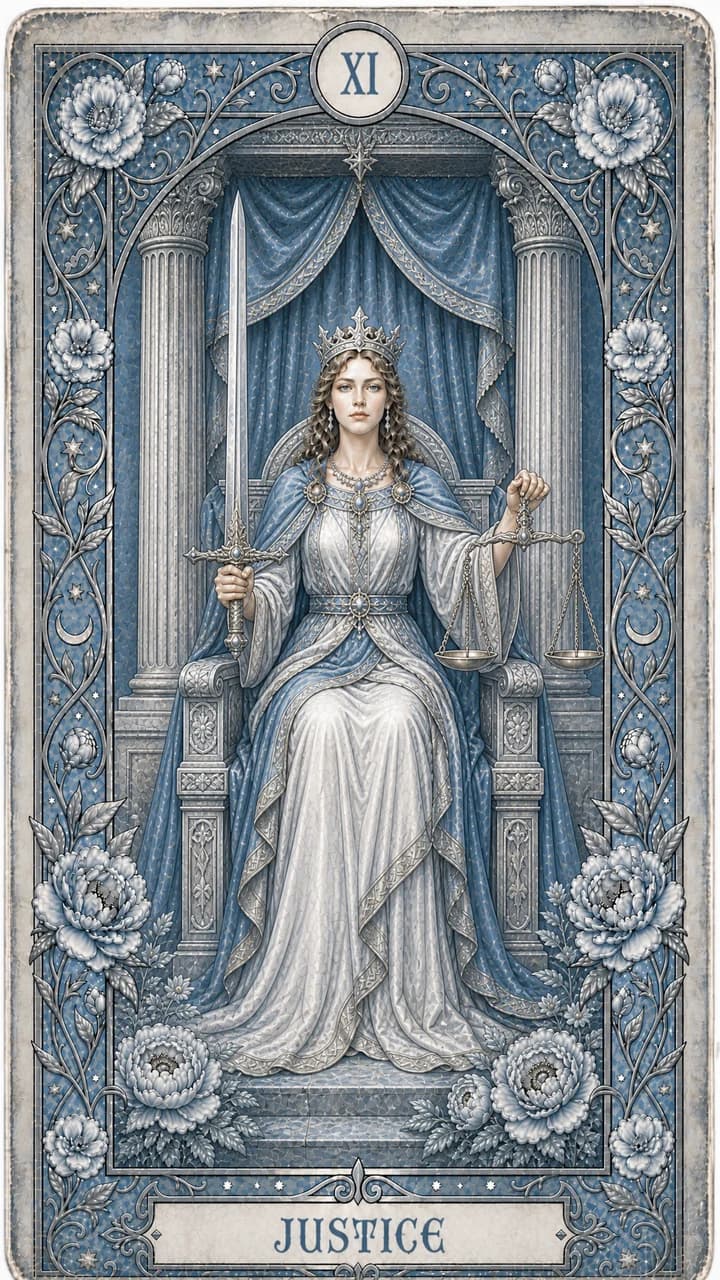
- The scales
- The scales represent weighing evidence and considering different interests before reaching a judgment.
- The upright sword
- The sword suggests clarity and a decision that can be acted upon. Deliberation must eventually lead to a considered conclusion.
- The two pillars
- The pillars provide an orderly setting, suggesting stable standards and a process that others can understand.
- The seated, forward-facing figure
- The composed posture expresses the ideal of careful, impartial attention rather than an impulsive reaction.
Common questions
Does upright Justice guarantee that I will win a dispute or court case?
No. It highlights evidence, procedure and responsibility, not a guaranteed verdict. Real disputes must be addressed through their actual facts, with qualified legal advice where appropriate.
Does Justice mean someone will get what they deserve?
Consequences are part of the card, but it cannot establish that the universe will punish a particular person. It should never be used to suggest that someone deserved mistreatment or misfortune.
Is Justice too cold to be a positive relationship card?
Its style is measured rather than demonstrative, but honesty and fairness can support affection. The card alone cannot establish emotional coldness; look at how the people involved communicate and treat one another.
Does reversed Justice mean everything is my fault?
No. It may concern unfair treatment, missing information or excessive self-blame. Responsibility should be assigned according to actual behavior, not the orientation of a card.
What is the difference between Justice and Judgement?
Justice weighs facts, standards and responsibility for a decision. Judgement looks back over experience and considers what a changed understanding now calls for. One emphasizes fair assessment; the other emphasizes recognition and response.